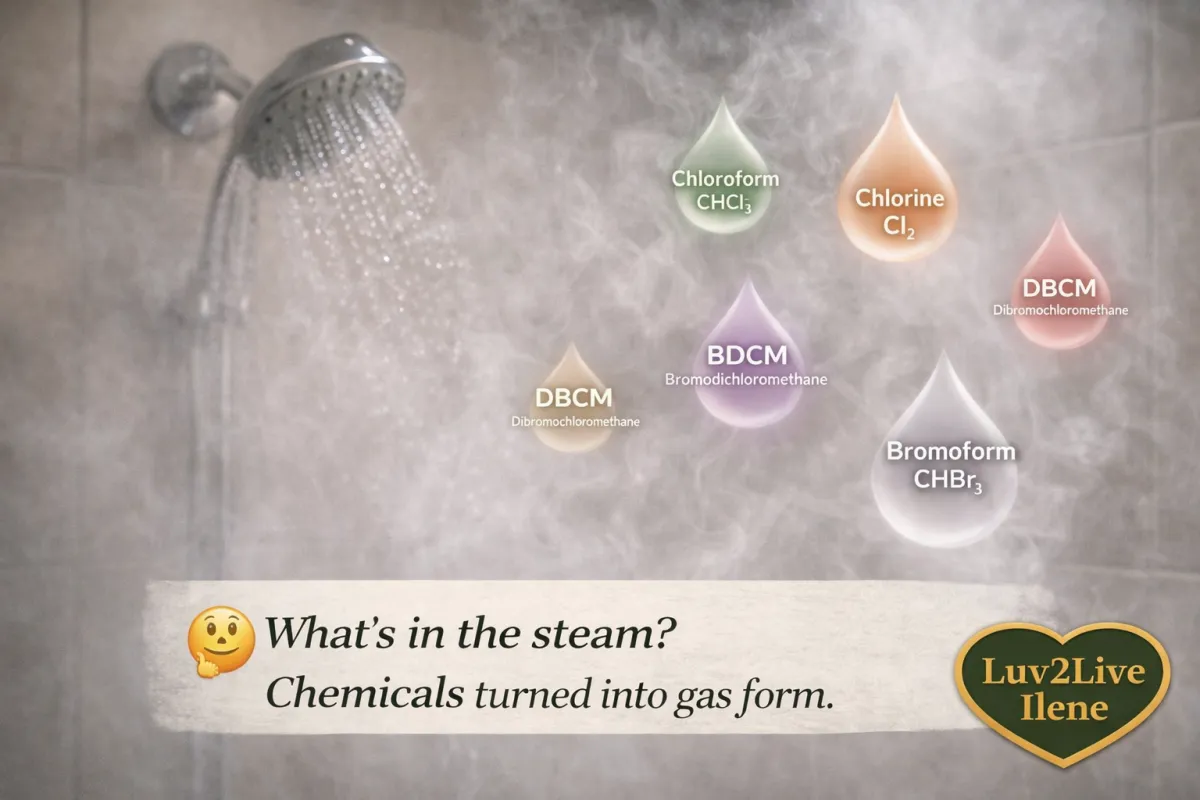
What's Really in Your Shower Steam - The Science Most People Never See
← Back to the Full Water Guide
Water · Science · You're Not Broken, You're Blocked
What's Really in Your Shower Steam
The hidden exposure most people never think about — and what the research actually shows.
Most people think about water quality when they drink it.
But what if one of your biggest daily exposures isn't from what you sip — it's from what you breathe and absorb every single morning before you've even had breakfast?
I'm not a scientist. I'm someone who got sick, spent years paying attention, and couldn't un-learn what I learned. This page is where I share the research behind one of the biggest aha moments in my water education. Read it. Follow the study links. Do your own thinking. That's always been my approach.
You're Not Broken. You're Blocked.
That's the foundation of everything I share at Luv2Live Ilene.
When people feel off — fatigued, inflamed, stuck in a health pattern they can't break — the first question is almost always: what's wrong with me? What did I do wrong? Is it my genes? Is it just who I am?
And the answer I've found, again and again, is simpler and more hopeful than that. It's not what's wrong with you. It's what's blocking you. And many of those blocks are environmental — things in your everyday surroundings that your body is quietly working against every single day.
Water is one of the most overlooked of those blocks. Not the water you're not drinking enough of. The water you're already using — every shower, every load of laundry, every glass from the tap — without ever questioning what's in it.
This post is specifically about the shower. Because of all the water education I've encountered in my journey, the shower research is the piece that landed hardest. Not because it's scary — but because it's so simple. And so completely overlooked.
You're not broken. You're blocked. And sometimes one of the biggest blocks is something you stand in for 10 minutes every morning and never think twice about.
It's Not Just Chlorine — It's What Chlorine Becomes
Most municipal tap water is disinfected with chlorine. That process serves a real purpose — it kills pathogens and makes water safer to distribute through a city-wide system.
But chlorine doesn't just stay chlorine.
When chlorine reacts with naturally occurring organic matter in water — things like leaves, soil, and decaying plant material — it forms a group of chemical compounds called trihalomethanes, or THMs.
The Primary THMs Found in Tap Water
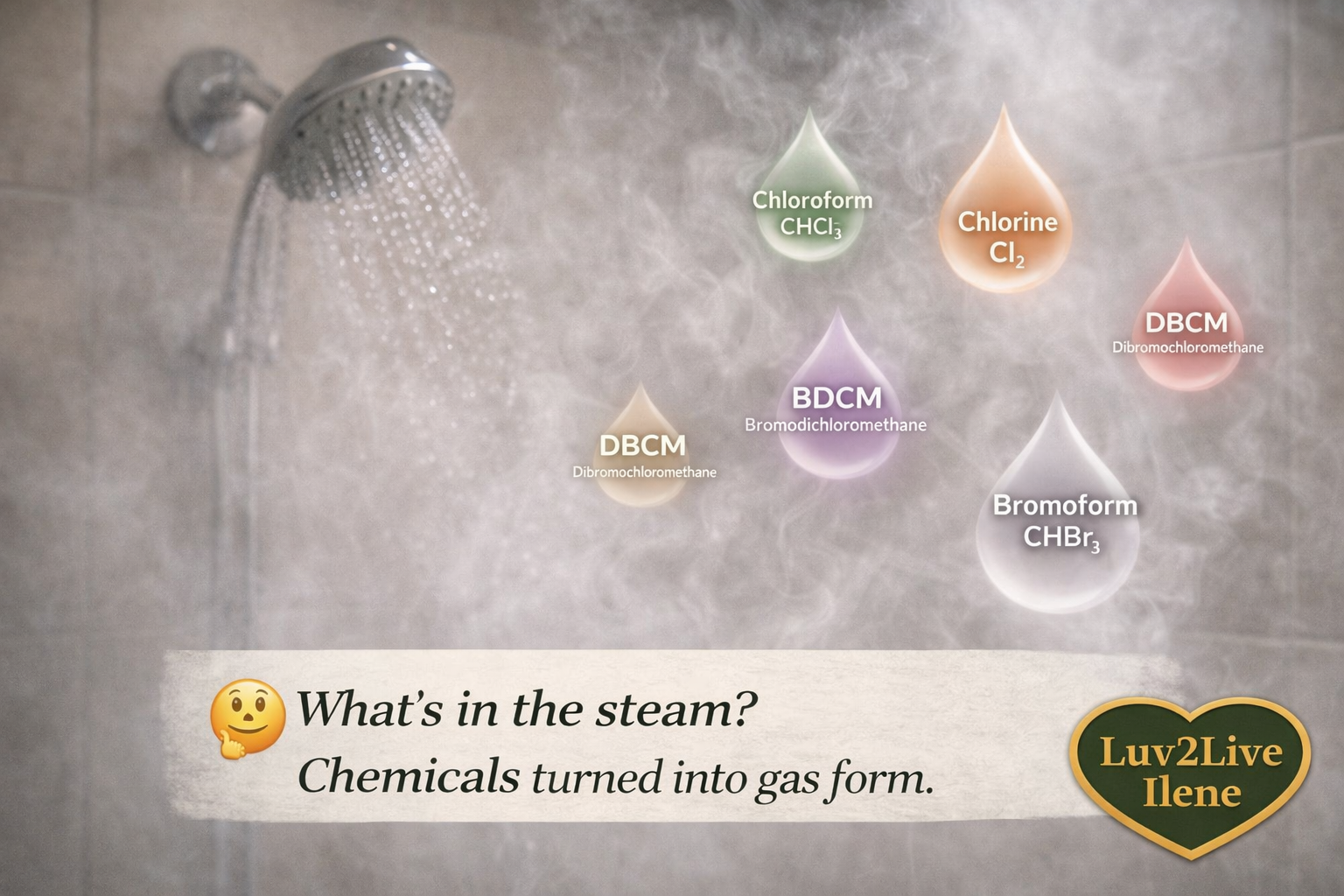
Chloroform (CHCl₃)
Bromodichloromethane (BDCM)
Dibromochloromethane (DBCM)
Bromoform (CHBr₃)
Of these, chloroform is the one that appears most frequently in research — and it is the one that volatilizes most readily from hot water into shower steam.
These compounds are classified as disinfection byproducts. The EPA regulates total THM levels in drinking water. What that regulation does not account for is inhalation exposure during showering. The regulatory framework for THMs is based primarily on drinking — not on what happens when that water is heated in an enclosed space and breathed.
The compounds formed when chlorine meets organic matter don't stay in the water when you heat it. They evaporate. They become the steam you breathe. And that's a completely different exposure pathway than drinking.
Why Your Shower Creates the Perfect Environment for Exposure
A hot shower is not just water. It's a combination of conditions that maximize your body's contact with whatever is dissolved in that water. Think about what's happening simultaneously in those ten minutes:
Four Things Happening at Once
Heat volatilizes chlorine byproducts— THMs evaporate from hot water readily, concentrating in steam at levels much higher than in the water itself.
Steam fills an enclosed space— unlike drinking, a shower fills the air around you. You cannot avoid breathing it.
Warm water opens your pores— the same mechanism that makes a facial steam treatment work. Heat signals pores to open, increasing the rate and depth of absorption.
You breathe deeply and continuously— unlike a brief moment of drinking, a shower is 10, 15, sometimes 20 minutes of sustained inhalation.
The result is three simultaneous exposure routes: inhalation through the lungs directly into the bloodstream — bypassing the body's digestive filtration entirely. Transdermal through the skin at an accelerated rate. And minimal ingestion through water droplets.
😏 Think of it this way: drinking water is like walking past something. A hot shower is like standing inside it — breathing it in, absorbing it through your skin — for ten minutes straight. Which one touches more of your body?
What the Research Actually Shows
This is not speculation. These are published, peer-reviewed studies from government health databases and scientific journals. I'm including the direct links so you can read them yourself — because I believe you deserve the primary source, not just a summary.
Note: I am not a scientist or medical professional. I'm sharing this research as an informed, curious person who wants others to have access to the same information I found. These studies measure exposure levels — not proof of direct harm in any individual. The interpretation is yours to make.
______________________________________________________________________
Study 1 — American Journal of Public Health (NIH)
What they did: Measured THMs in participants' breath and blood after different household water-use activities — drinking, showering, and bathing.
What they found: Showering and bathing significantly increased THM levels in the body. Drinking water produced much smaller increases.
→ Key takeaway: Exposure through skin and inhalation can exceed drinking alone.
Read the full study at pmc.ncbi.nlm.nih.gov/articles/PMC1440773/
_______________________________________________________________________
Study 2 — Environmental Exposure Comparison
What they did: Compared internal THM levels from multiple water-use activities — drinking water, showering, washing hands and dishes.
What they found: Showering and bathing produced higher internal THM levels than drinking water.
→ Key takeaway: Water exposure isn't just about what you drink — it's about what your body absorbs.
_______________________________________________________________________
Study 3 — Science of the Total Environment
What they explain: Heat significantly increases the volatility of chlorine disinfection byproducts. When water containing these compounds is heated, the compounds move from liquid into the surrounding air at an accelerated rate.
What this means: The air in your shower contains concentrations of THMs meaningfully higher than the water itself. Inhalation becomes the dominant exposure route.
→ Key takeaway: The steam is more concentrated than the water.
Read the study at ScienceDirect
_______________________________________________________________________
Study 4 — PubMed / National Library of Medicine
What they found: Warm water increases both the formation and release of disinfection byproducts. Inhalation and transdermal exposure are significant contributors to total THM body burden during showering.
→ Key takeaway: Your lungs and skin are both active pathways — not just your digestive system.
_______________________________________________________________________
Four independent studies.
The same conclusion across all of them: showering and bathing contribute significantly to the body's THM load — and in multiple studies, more so than drinking the same water.
This is documented in peer-reviewed, government-indexed research.
_____________________________________________________________________
What Happens Inside the Body — And Why the Route Matters
When you drink water — even water with THMs in it — your body has a filtration process. The compounds pass through your digestive system. Your kidneys and liver do their job. It's not perfect, but there's a checkpoint system working on your behalf.
When you inhale a compound, that checkpoint doesn't exist.
The Direct Route
They enter through the lungs. Your lungs are designed for gas exchange — oxygen in, carbon dioxide out. They move things directly into the bloodstream. That's their job.
They can move directly into the bloodstream. No digestive processing.
They circulate through the body. The blood carries them to every organ and system. Brain 🧠, heart, kidneys . . .
Chloroform specifically has a molecular weight of 119. Anything below 150 molecular weight can also enter the bloodstream through skin contact. During a hot shower, chloroform is entering through two routes simultaneously — lungs and skin — both bypassing digestive filtration.
_______________________________________
😏 I think about it like this: if you took a supplement that bypassed all your body's normal processing and went straight into your bloodstream, you'd want to know what was in it.
That's essentially what shower inhalation is.
Except nobody put it on a label.
_______________________________________________________________________
The route of exposure changes everything.
Drinking gives your body a chance to filter. Inhaling skips the line.
That's not a wellness opinion. That's respiratory physiology.
______________________________________________________________________
Keeping This Honest and Grounded
I want to be direct about what this research does and doesn't say. Because I am not interested in fear. Fear is not a tool I use and it doesn't support good decision-making.
What the Research Shows
These studies measure exposure levels — specifically, how much of these compounds end up in the body after different water-use activities. They demonstrate that showering and bathing are significant contributors to total THM body burden.
What the Research Does Not Claim
These studies do not say "one shower will harm you." They do not establish a specific threshold of harm for any individual. Human biology is complex, cumulative exposure is highly individual, and the science in this area continues to develop.
What I Take From It
The pattern across four independent studies is consistent: the shower is a meaningful exposure route that the standard water-quality conversation ignores. Given that most people shower daily for their entire lives, the cumulative picture is worth paying attention to — not with alarm, but with awareness.
Awareness is not the same as alarm. Awareness is what allows you to make an informed choice. And you are not stuck. You are not broken. You are just working with information you may not have had before.
The Cumulative Piece — Why Daily Exposure Compounds
No single shower is the issue. The question is what happens when you shower in unfiltered tap water every day for years. Decades. A lifetime.
I've used the penny analogy before — one penny doubled every day for 30 days becomes over five million dollars. No single day looks dramatic. The compounding is the whole point. The same principle works in reverse when it comes to environmental burden. A small daily load, accumulated quietly over years, adds up to something the body has to continuously process and manage.

The Body's Reserve Account
I think about health like a bank account. You want to live with reserves — enough in the account that when something harder comes along you have something to draw on. Every daily environmental burden is a small withdrawal. Reducing those withdrawals — including what's in your shower water — is how you protect your reserves. Not overnight. Not dramatically. But consistently, cumulatively, in the direction of a body that has more capacity to handle what life brings.

_______________________________________________________________________
The goal isn't a perfect, toxin-free existence. That doesn't exist.
✅The goal is reducing the unnecessary burden wherever you reasonably can
—
so your body's remarkable systems can
✅Spend that energy on things that actually matter.
______________________________________________________________________
And Then There's What We Put Back In
Here's a loop I had to sit with for a while. Think about everything that goes down our drains in a week. The colored toilet bowl tabs. The bleach-based cleaners. The fabric softeners. The drain openers. The floor cleaners. All of it enters the wastewater system. And in many municipalities, a significant portion of that water is treated and recycled back into the supply.
What it can't remove returns to us. Or it enters the environment. Back into groundwater. Back into rivers and streams. Back to us anyway.
😏 We are, in a very literal sense, cleaning our toilets with the same water we're going to shower in. The question is just how many steps are in between — and how thorough those steps actually are.
I'm not saying this to create guilt. I used those products too. But understanding this loop shifted two things for me: I became more intentional about what goes down my drain, and I understood that a home filtration system isn't just about what comes in from outside. It's about building a layer of protection in both directions.
We didn't create this system alone. But we can make smarter choices within it — one ingredient at a time, in both directions.
What You Can Actually Do — Practical and Real
You don't have to panic. You don't have to overhaul everything overnight. One ingredient at a time. In the direction of better.
__________________________________
Start With the Shower
Shower filters are one of the most accessible first steps for reducing chemical exposure at the source. Two different tools worth knowing about — they serve different purposes and can work together:
For reducing chlorine and chemical byproducts: pH Prescription offers a shower filter designed to reduce chlorine and its byproducts before that water heats into steam. If you're already considering a whole-home system, ask their team about adding a shower filter. Mention Ilene and use code LUV10 for 10% off. → Click Here
For enhancing water quality and skin hydration: Mizue by Aquadei is a different category entirely — an ultrafine bubble nozzle that attaches to your existing showerhead. It produces nanoscopic bubbles that penetrate the skin's outer layer for deeper hydration and cleansing. A blinded study showed a 211% increase in skin surface moisture after 5 minutes compared to a standard shower. Worth exploring if water quality and skin health are both priorities. → Click Here
Neither requires a plumber. Both address the shower as the specific environment this entire post is about — just from different angles.
Disclosure: I am an affiliate of pH Prescription and may receive compensation through my referral link and code LUV10 at no additional cost to you. Mizue by Aquadei is referenced as a resource only — I have no affiliate relationship with Aquadei.
__________________________________
Consider the Whole Home
The shower is one tap. But your bath, your laundry, your dishwasher — everything that uses hot water and generates steam or skin contact — all runs on the same supply. A whole-home filtration system addresses your entire water environment, not just one faucet. It also means the water that feeds your drinking system is pre-filtered — better performance and longer filter life.
__________________________________
Know What's in Your Water First
Before spending a dollar on any system, know what you're working with. Independent laboratory testing gives you the actual picture. I recommend National Laboratories atwatercheck.com— licensed in all 50 states, mail-in kit, you choose what to test.
__________________________________
Talk to Someone Who Knows
I am not a water expert. But I've found one I trust — Leo Szymborski, founder of pH Prescription, with over 30 years of water science experience. When you're ready to explore home water filtration, I point people directly to his team. They ask about your home, your water source, your location, and your goals. They don't upsell. They find what fits. Use codeLUV10for 10% off.
Explore Home Water Filtration — pH Prescription
Test Your Water First: Book a Free Discovery Call
Affiliate disclosure: I am an affiliate partner of pH Prescription LLC and may receive compensation when purchases are made through my referral link or code LUV10, at no additional cost to you. I chose this company before I had that relationship. I use their systems in my own home. watercheck.com is referenced as a resource only — I am not an affiliate of National Laboratories.
You're not Broken. You're Blocked.
And sometimes the thing that's been quietly in the way is so ordinary — so daily — that you never thought to look at it. I didn't question my shower for decades. Most of us don't. That's okay. You're looking at it now. And that's the beginning of something.
One ingredient at a time. Whole healing — body, mind, spirit.
Reset your health. Reinvent your life.
Common Questions About Shower Water and THM Exposure
__________________________________
Is shower water actually dangerous?
Research does not characterize daily showering as acutely dangerous. What studies document is that showering in chlorinated tap water is a meaningful contributor to the body's total trihalomethane (THM) load. In multiple peer-reviewed studies, showering and bathing produced higher internal THM levels than drinking the same water. The significance of this over a lifetime of daily exposure is the conversation worth having.
__________________________________
What are trihalomethanes and why do they matter?
Trihalomethanes (THMs) are chemical compounds — primarily chloroform, bromodichloromethane, dibromochloromethane, and bromoform — that form when chlorine used to disinfect water reacts with naturally occurring organic matter. They are classified as disinfection byproducts and are regulated in drinking water. Research has associated elevated THM exposure with increased risk of certain cancers and reproductive effects in long-term epidemiological studies.
__________________________________
Does a hot shower expose you to more chemicals than drinking water?
Multiple peer-reviewed studies have found that showering and bathing produce higher internal THM levels than drinking the same water. Heat causes THMs to volatilize from water into steam, concentrating them in the enclosed shower space. Inhalation delivers these compounds directly into the bloodstream via the lungs, bypassing the digestive filtration that occurs when you drink.
__________________________________
Does a shower filter actually help?
Shower filters — particularly those using KDF filtration media — are specifically designed to remove or reduce chlorine and some of its byproducts from shower water. They reduce the compounds available to volatilize into steam and to be absorbed through skin. A whole-home filtration system provides broader protection by filtering all water at the point of entry into the home.
__________________________________
What is "you're not broken you're blocked" and how does it relate to water?
That phrase is the foundation of Luv2Live Ilene's philosophy. When people feel stuck in their health — fatigued, inflamed, unable to make progress — the question is often not what's wrong with them but what is blocking their body from functioning as it's designed to. Environmental blocks — including what's in your shower water — are among the most overlooked. Addressing those blocks doesn't require perfection. It requires awareness and one step at a time.
What studies show that shower water exposure matters?
Key research: Changes in Breath Trihalomethane Levels — American Journal of Public Health|Risk from Exposure to THMs During Shower — PubMed|THM Volatilization Study — Science of the Total Environment
__________________________________
How do I find out what is in my tap water?
Independent laboratory testing is the most reliable method. I recommend National Laboratories atwatercheck.com— licensed in all 50 states, mail-in kit, comprehensive testing including VOCs, heavy metals, pharmaceuticals, and PFAS. Your municipality's annual report reflects treatment plant averages — not what comes out of your specific tap after traveling through your home's pipes.
Let's Chat
→Book a Free Discovery Call with Ilene
Disclaimer: The information on this page is for educational purposes only and does not constitute medical advice. It is not intended to diagnose, treat, cure, or prevent any disease or health condition. Study summaries are paraphrased for accessibility — always read primary sources directly for full context. Always consult a qualified healthcare provider before making changes to your health environment or regimen.
and what the research actually shows.